
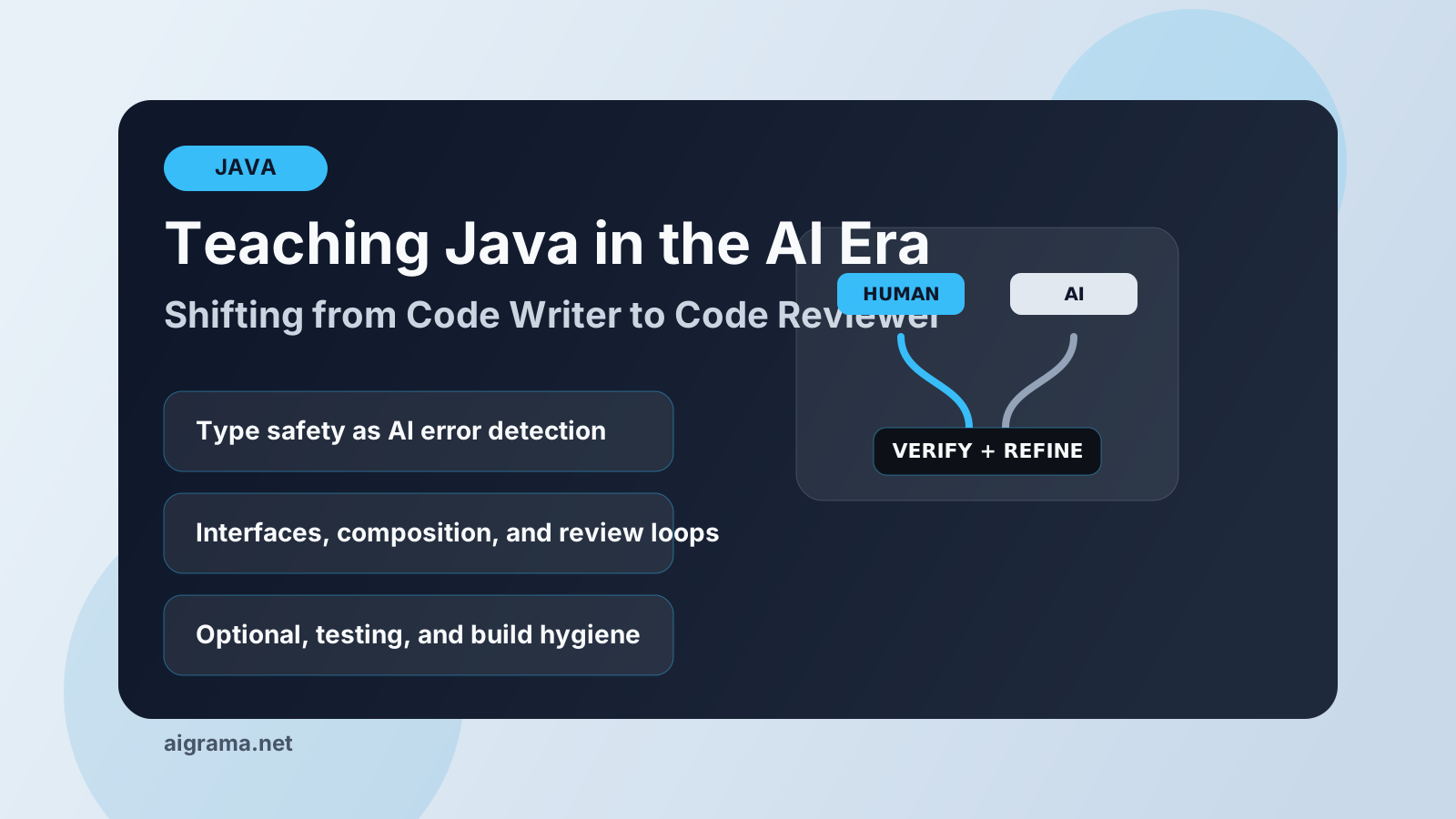
Learning Java in the AI Era: Shifting from Code Writer to Code Reviewer
A modern Java curriculum for the AI era teaches developers to design contracts, review generated code critically, and verify correctness instead of only writing syntax.
Today, Artificial Intelligence (AI) can write code in seconds. That changes what good Java developers need to practice. The job is moving away from typing syntax by hand and toward designing boundaries, reviewing generated code, and proving that the final system is correct.
This article outlines a Java curriculum for that shift. The goal is not to turn students into prompt operators. The goal is to train them to act like architects and critical reviewers who can use AI productively without trusting it blindly.
The New Developer Workflow
The modern workflow is simple: the human defines the blueprint, AI produces a fast first draft, and the human verifies whether the result is safe, correct, and maintainable.
That loop is the real skill. Students still need to understand syntax, but syntax alone is no longer the differentiator. Judgment is.
Module 1: Java’s Type System and Data Integrity
AI is fast, but it also hallucinates. In software, that means it can invent APIs, misuse libraries, or apply rules that do not actually exist. Java’s type system is one of the best defenses against that kind of failure.
1.1 The JVM Lifecycle and Mental Execution
- Simple explanation: Java runs on the Java Virtual Machine (JVM), which lets the same compiled code run across Windows, macOS, and Linux.
- The skill: Students should learn to mentally execute generated code line by line to see whether the logic is actually coherent.
1.2 The Compiler as Your First Defense
- Simple explanation: Java is statically typed, so values must match the types the program declares.
- What to watch for: AI often generates raw collections, vague method signatures, or mismatched return types. The compiler catches many of those issues immediately.
1.3 Variables with var
- Simple explanation:
varis useful when the inferred type is obvious from the right-hand side. - What to watch for: AI tends to overuse
var, which can hide intent and make review harder when the type is not immediately clear.
1.4 Value Types vs. Reference Types
- Simple explanation: Some Java values are simple primitives, while others are object references with identity and behavior.
- What to watch for: AI regularly compares objects with
==when the code should use.equals(). That mistake looks harmless and still causes real bugs.
1.5 Modern Data Carriers: Records and Lombok
- Simple explanation: Modern Java records provide concise, immutable data carriers with far less boilerplate.
- What to watch for: AI often falls back to verbose legacy classes with repetitive getters, setters, and constructors even when a record would be the cleaner choice.
1.6 Enums vs. Magic Strings
- Simple explanation: Enums model a fixed set of valid choices.
- What to watch for: AI likes string literals such as
"PENDING"or"APPROVED". Those values are fragile and easy to mistype across a codebase.
Module 2: The Object Model as a System Blueprint
AI can generate local code quickly, but it is weak at preserving a coherent system design across multiple classes, layers, and services. Humans still need to define the shape of the system.
2.1 interface as the Ultimate AI Prompt
- Simple explanation: An interface defines what a component must do without prescribing how it does it.
- Why it matters: If students define clean interfaces first, they can ask AI to implement against clear contracts rather than vague intentions.
- What to watch for: Generated implementations may satisfy the method signature while still doing something slow, wasteful, or hard to test.
2.2 Composition over Inheritance
- Simple explanation: Systems are usually easier to change when built from small collaborating pieces instead of rigid inheritance hierarchies.
- What to watch for: AI frequently creates deep class trees because inheritance looks structurally neat, even when composition would be simpler and safer.
2.3 Dependency Injection and the Spring Container
- Simple explanation: Dependency injection means components receive what they need from the outside instead of building those dependencies internally.
- Why it matters: That pattern improves testing, decoupling, and replacement of infrastructure concerns.
Module 3: Control Flow and Logic Traps
AI performs well on common control flow, but edge cases still expose it quickly. Students need to learn where generated logic usually breaks.
3.1 Streams vs. Loops
- Simple explanation: Streams let developers express collection processing in a declarative way.
- What to watch for: AI can create stream pipelines that look elegant but allocate too much, nest poorly, or behave badly on large datasets.
3.2 Optional<T> and the Death of Null Pointer Errors
- Simple explanation:
Optionalmakes absence explicit instead of leaving null checks scattered through the code. - What to watch for: AI often calls
.get()directly, which defeats the whole point of usingOptionalsafely.
A reliable review habit is to scan every generated
Optionalpath and ask whether absence is handled intentionally or only assumed away.
3.3 Proper Error Handling
- Simple explanation: Good error handling preserves context and fails in a controlled way.
- What to watch for: AI loves catch-all blocks such as
catch (Exception e), which usually hide the real cause and weaken recovery logic.
Module 4: Code Archaeology, Build Systems, and Testing
In the AI era, writing code is cheaper than reading it. That means students need to become good at code archaeology: understanding unfamiliar code, finding its assumptions, and validating whether it is safe to keep.
4.1 The Code Review Checklist
Every generated change should face a short but strict review checklist:
- Does it handle empty or invalid input?
- Are file, database, and network resources closed safely?
- Does it leak data or create obvious security risks?
- Does it preserve the existing contract and edge-case behavior?
4.2 Testing-First Thinking
Humans should define the behavioral rules first, then let AI draft the tests and implementation. Students still need to audit those tests closely, because generated tests often validate the happy path while missing the actual failure modes.
4.3 Build Systems: Maven and Gradle
- Simple explanation: Build tools manage dependencies, compilation, packaging, and automated checks.
- What to watch for: AI may suggest outdated libraries, invalid version coordinates, or combinations of plugins that technically compile but are poor operational choices.
Module 5: The Capstone Project
The final proof of learning is an end-to-end project where the student acts primarily as the architect and reviewer instead of the raw code producer.
| Phase | Human responsibility | AI responsibility |
|---|---|---|
| Architect | Define contracts, boundaries, and constraints | Draft implementations against those contracts |
| Audit | Review correctness, security, and maintainability | Revise code based on review feedback |
| Test | Specify expected behaviors and edge cases | Generate tests and supporting fixtures |
| Refactor | Change requirements to test flexibility | Adapt the implementation safely |
This structure teaches the habit that matters most: generated code is not a finished product. It is a proposal that must be evaluated.
Conclusion
The most valuable Java developers in the AI era will not be the fastest typists. They will be the engineers who can define clean contracts, recognize weak abstractions, question generated output, and verify behavior before it reaches production.
That is the educational shift worth making. You should still learn how code is written, but the deeper skill is learning how code should be judged.
Subscribe & Follow
Get notified of new technical articles on AI/ML, Java, Python, and system architecture.